Autumn in the Belarusian Lakeland, or Why Yelnya Is Worth the Trip
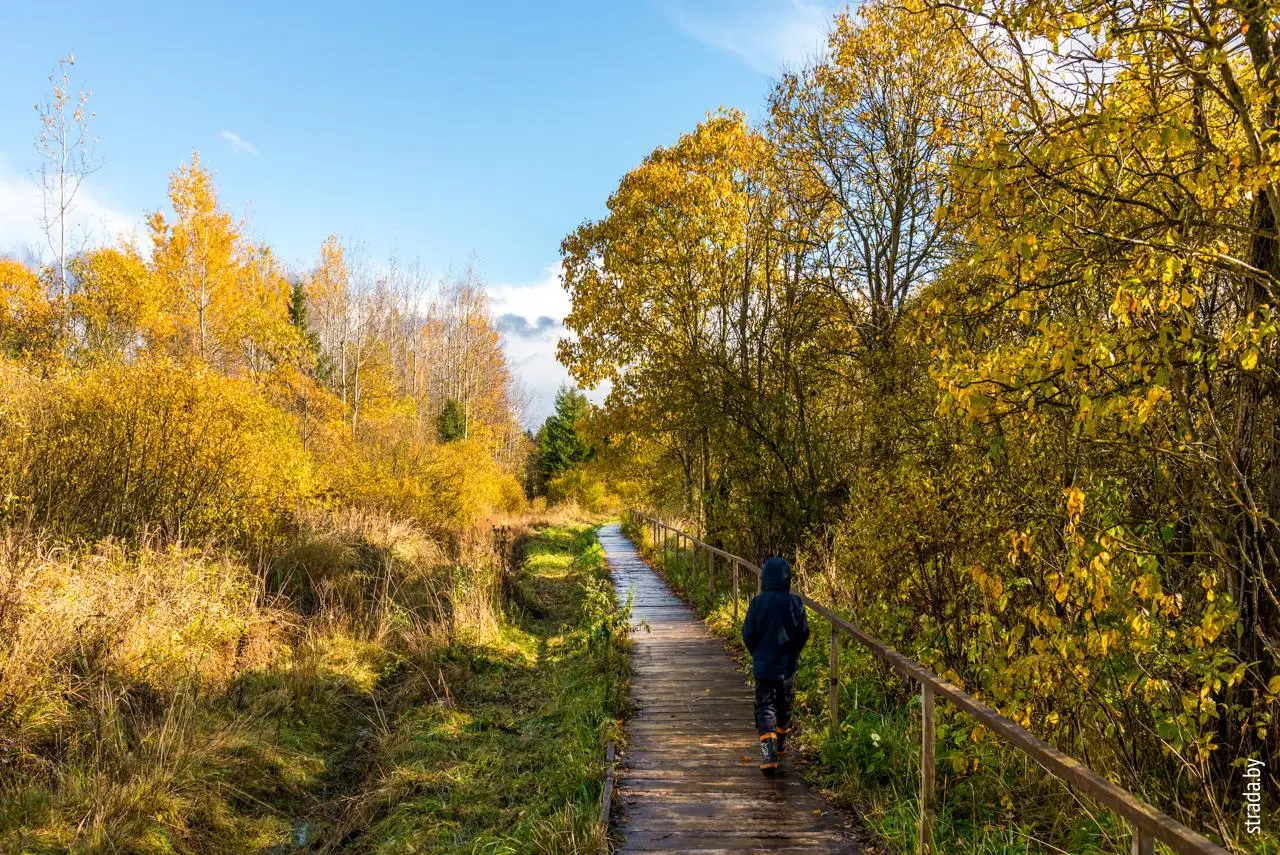
There is a particular moment in the Belarusian autumn when the green of summer begins to give way to gold and crimson, the air turns clearer, mist settles over the fields in the morning, and nature seems to pause briefly before the cold arrives. And if you want to see that Belarus — quiet, ancient and almost untouched — head to the north of the country, to our Lakeland. To where, among the forests and lakes of the Vitebsk region, lies one of the most remarkable places in Belarus: Yelnya.
This is not just another nature reserve, and it is certainly not the kind of swamp we picture from books and films. Yelnya is a different world altogether.
The national landscape reserve lies mainly in the Miory district and partly in the Sharkovshchina district. At its heart is the largest expanse of raised bog in Belarus, more than nine thousand years old. The unique forest-and-bog ecosystem preserved here is the reason the territory was given its protected status.
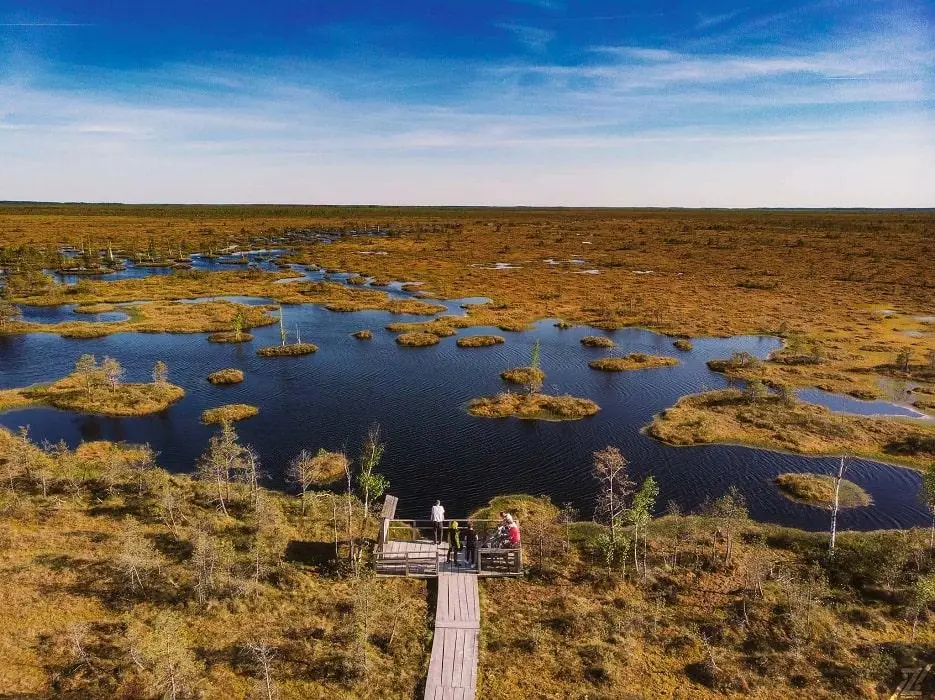
What strikes you most when you first step out onto Yelnya is the space. The horizon becomes unfamiliarly distant. The low northern sky is reflected in the dark water of small lakes and pools. Underfoot are sphagnum mosses, wild rosemary, heather, dwarf birches and berries. Somewhere in the distance, solitary pines stand dark against the light.
And all around — silence. Not the city silence of an early Sunday morning, when a car can still be heard somewhere. The real silence of an immense natural space that existed long before our towns and roads.
But why autumn in particular?
Because autumn is Yelnya at its most singular. Through August and September the bog vegetation gradually changes colour. Green gives way to ochre, gold, red and burgundy. Against a cold blue sky those colours look especially vivid.
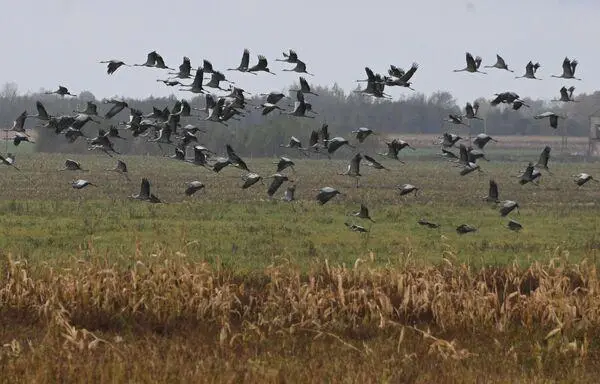
But the main event of the autumn is the birds. Common cranes stop at Yelnya during their seasonal migration. They rest here and gather strength before flying on. In this period you can see large flocks of cranes above the surrounding country, and their distinctive calls become part of the landscape itself. Thousands of cranes arrive here in autumn.
Perhaps that is when you understand why the crane appears so often in Belarusian culture, poetry and folk imagery. You stand in the middle of a northern landscape, hear a distant crane call — and the modern world seems to step back for a while.
And autumn at Yelnya also means cranberries
Red berries are scattered right through the bog vegetation. Cranberries have long been not only a natural asset here but one of the emblems of the Miory area. It is no accident that the crane and the cranberry come together in the name of the well-known local ecological festival Zhuravli i Zhuraviny Miorskaha Krayu — Cranes and Cranberries of the Miory Land.
It makes a strikingly precise image of Yelnya: cranes overhead, cranberries underfoot. And all of it within one of the oldest landscapes in the country.
Can you see a bog without wading into it?
You can. An ecological trail, Ozeravki — Yelnya, has been built for visitors. Part of the route runs along a wooden boardwalk that lets you go a good way into the bog and see it from the inside without damaging the fragile ecosystem. The trail leads out to open expanses of bog and a small lake.
And this is exactly where I would advise you not to hurry. Yelnya sits badly with words like faster, fit it in, and see it in twenty minutes.
You need to stop. Look at the water. Listen to the wind. Follow a bird with your eyes. Look closely at the moss underfoot and at the tiny plants that need nothing more than water, sun and a few centimetres of bog soil to live.
Sometimes a journey is remembered not for the number of sights seen but for a single moment like that.
The Lakeland is a Belarus many people have yet to discover
We are used to showing guests Minsk, Mir, Nesvizh, Brest and the Belovezhskaya Pushcha. And rightly so — a journey through Belarus is unimaginable without them. But the north of the country opens up an entirely different Belarus. A Belarus of small towns, glacial lakes, old churches, rolling roads, pine forests and enormous sky.
And Yelnya becomes one of those places after which the familiar word bog looks different. There is nothing gloomy or threatening about it here. On the contrary — space, air and an extraordinary calm.
What else would I add to a trip to Yelnya?
If you are coming from Minsk for a day or two, do not limit yourself to the trail alone. See Miory, drive the roads of the Belarusian Lakeland, linger by the smaller lakes, try the local food. The route can be extended with other natural and historical sites in the northern Vitebsk region.
Above all, leave yourself enough time so the trip does not become a race between points on a map. The Lakeland in autumn is best discovered slowly.
So why go to Yelnya after all?
To see Belarus without the stage set. To walk above an ancient bog on a wooden boardwalk. To see red cranberries among golden moss. To hear the cranes. To meet sunrise or sunset somewhere with almost no trace of the modern world in sight.
And perhaps simply to remember, for a few hours, what a real horizon looks like.
Autumn in Belarus is short. That is exactly what makes journeys like this so valuable. If one September morning you feel like leaving Minsk behind and heading somewhere the wind and the cry of cranes replace the noise of the city — remember Yelnya.
You may well discover a completely different Belarus there.
Andrei, Director of BelDiscovery